“I still hear the sound in my ears of a great many people talking or making a noise. It is almost unbearable in the long run.” – Vincent van Gogh’s Letter 741, Letter to Theo (February 1889)
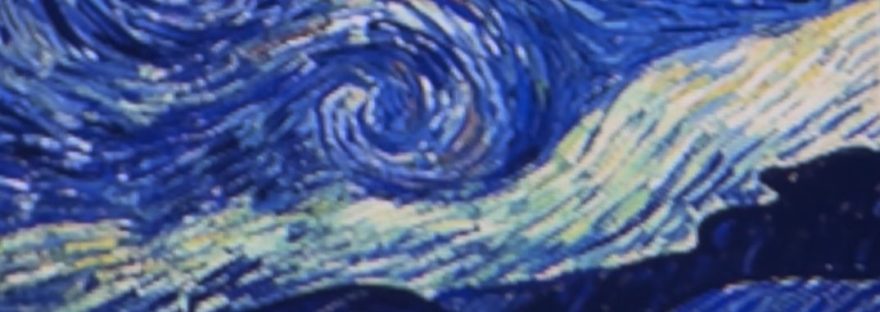
When M told me that the van Gogh immersive experience was on during my birthday, sirens went off in my mind. I had seen videos of it before, knowing that it could be extremely triggering to my Meniere’s. But, I have been really curious about it as well, especially since I got sick, because many believe that one of the illnesses van Gogh might have had is Meniere’s. In 19th Century Europe, inner ear illnesses and mental health issues were often conflated; clearly, we have made significant progress on that front!
Four years ago, I rung in my 30th birthday with a walking stick; this year, my ears rang them in with a hearing aid. It’s a steep learning curve, and every time this illness progresses, my acceptance regresses. It’s been just two weeks since I got the hearing aid, and in addition to adjusting to it, I am once again confronting my own internalised ableism. What’s been really helpful in this process is reading ‘The Country of the Blind’. Written by Andrew Leland, the book documents the author’s journey of going blind, and finding his place in the culture. Leland writes beautifully about discovering this new sense of self, and wondering how this new reality would change him. The flux, he writes, is not only about being too sighted to be blind, and too blind to be sighted, but also about the “need to know how I will live, and what kind of blind person I’ll be. How will I travel independently? How will I write, and read, and work? How will I watch movies, or appreciate art?” Later in the book he reflects that “Figuring out what sort of blind person I should be has become in some ways indistinguishable from the ongoing process of figuring out what kind of person I am, or want to be, regardless of my disability.” At the end of the day, that’s what it really is, isn’t it? Reading this while I turn 34 and adjust to my hearing aid has been the perfect recipe for a full-blown existential crisis.
Enter Vincent van Gogh.
As I stood there with my walking stick by my side, I watched people say they felt “dizzy” and “disoriented” because of the moving (no pun intended) images of van Gogh’s work on the floor. I told M that this is how I feel – like walking on waves while standing still – sans the beauty of Gogh’s colours. We didn’t immerse ourselves in just his art, but also his mind. As I saw him, I felt seen. Seen my a man who died 135 years ago, and lived on another continent. But, he also lived in his mind, a place familiar to so many of us. It’s in his eyes in the self-portraits; the slight frown and the depth of pain (or is it the hollowness of reality). Gogh wrote about this as well, the feeling of having to start over because of the illness. In a letter to Theo, his brother, he writes, “If I recover, I must start over again. But it will not be easy. My illness has broken me physically and morally.”
That’s the thing with chronic illnesses and disabilities; you keep trying to make sense of it, this entity that lives within you, is you, but also not. You cannot fully understand it or even who you are with it. On top of this is all the paraphernalia that comes with it – canes, hearing aids, etc. The adjustment to this is in waves, as Leland writes. “Even now, almost a decade later, I still feel pangs of cane-related embarrassment or fraudulence nearly every day.”
You are confronted by the darkness of it all, and as your senses adjust to it, you start to realise that what van Gogh wrote was true. “I often think that the night is more alive and more richly coloured than the day.” There’s a common thread between what Leland writes and Gogh experiences – that illness can make two conflicting, dichotomous ideas be true in the human experience. Gogh wrote poetry about darkness, he painted colours that lit up the world, and in the end, there was no light left. Leland, of course, writes in lighter shades about this experience, but it hits as hard.
“I’m going blind not just once, but over and over. Even when I lose a clinically tiny amount of vision – say, an eighth of a degree of my visual field – the decline feels catastrophic. Another chunk of sight – gone! I think. The whole edifice will surely collapse now…But then it stabilizes. Months tick by with no new changes. What once felt like a gaping hole in a crumbling ruin begins to feel normal, invisible, an everyday feature of the landscape.”
This is where I am now. I have lost a clinically tiny amount of my hearing, but the decline feels catastrophic. Enough to panic-search ISL (Indian Sign Language) courses, worried that I will lose my voice with my hearing.
What are we left with then? When the words of the poems run out, the paint dries, and we are back to the mundane reality of everyday life with this disability?
The human experience.
Article by Roshini Suparna Diwakar

 THE GLASS ELEVATOR
This is beautifully written. We’re all here to make the declines feel less catastrophic.
LikeLiked by 1 person