Has disability become performative?
Depends…
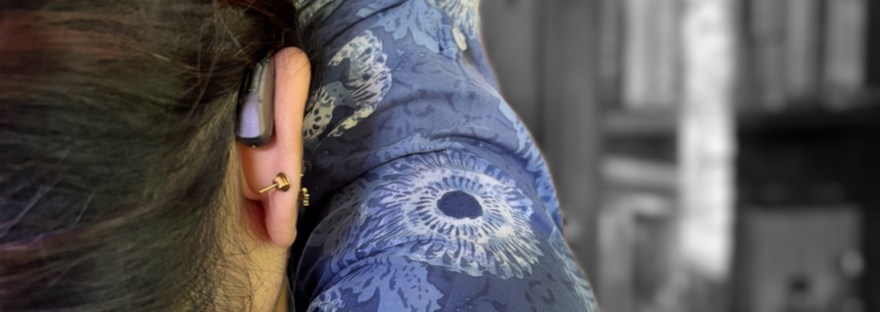
I am coming up on five years with bilateral Ménière’s disease (MD), a progressive chronic illness that has affected my vestibular and auditory systems. Half a decade ago, it began with ringing in my ears, and then a woozy feeling of walking on water. Over time, my right ear graduated to hearing loss, while my left ear tried to catch up with roaring tinnitus and constant fullness.
The thing about MD is that, in the early years, the hearing loss fluctuates. When I started writing this, I could distinguish voices in the crowded restaurant I was at. By the time I am done, my left ear is full, the ringing is high, and the voices have become blurry; I am listening to people like I am under water.
Lately, I have been struggling to hear conversations in noisy environments. After a couple of “pardon?”s, I just ask the person next to me in a whisper: “What did they say?”. I bit the bullet today and went for an audiometry; “no change”, she said. I should be happy, right? No deterioration since my last audiometry. Here’s the thing about such illnesses – those that are rare, chronic, unpredictable, invisible. You need evidence on paper to prove to people that “it’s not all in your head”. (It is, most definitely, in my head, just not in the way they mean!)
The thing about Pure Tone Audiometry tests is that they are done in soundproof rooms, and with single notes played on earphones. That’s not the real world, though! The real world is noisy, loud, and a mix of sensory cues, all of which is an overload for a damaged system. So, I spoke to my audiologist, a lovely young doctor who is approachable and willing to listen (pun definitely intended). She took me out into the crowded waiting room of the hospital, stood a couple of feet away from me and covered her mouth while she spoke to me. It was such an ‘Aha’ moment for me because I realised that I had inadvertently started reading lips to compensate for the times I could not hear clearly. “I’m not making it up!”: I tell myself.
I’ve been reading a book called ‘Losing Music’ by John Cotter. It’s a memoir by a teacher who has Ménière’s. It takes him a long time to accept that he is losing his hearing, that there is something truly wrong. When the symptoms disappear, it is a relief. When they return, it is denial. He candidly writes: “I’m white, male, cisgender – for someone in a position of such social privilege to find himself falling into any amount of marginalisation is a shock”. This is especially true when “I’m not deaf all the time.” “One minute I could hear as well as always and the next I’d have to lean too close to people, my ear nearly touching their mouths.”
This month, I started learning Basic Indian Sign Language, and the biggest question I have been grappling with is – Am I learning as an ally or as part of the community?
Deaf culture is complex, both in India and globally. I have just started dipping my toes in it, trying to understand the dynamics between hearing aid/cochlear implant users and those who opt out. Who gets to ‘represent’ the community? As someone born hearing, has just started to lose their hearing, and has whole-heartedly embraced the aid without a second thought, do I even belong to the community?
Aside from all this noise in my head (the questions, not the tinnitus!) is the very real lived experience of MD. I’ve written this while seated at a restaurant because I am too dizzy to stand up and leave. In all likelihood, I’m going to puke my guts out because of the motion sickness, which will lead to louder tinnitus that will overtake any external sound, and then the disorientation, exhaustion, etc… (I was 100% right, and all of this happened when I got home.)
In the world of social media, living authentically also feels like a performance. Yesterday, I posted on LinkedIn about being open to consultancy work. In the post, I mentioned my Ménière’s and the use of a hearing aid. I thought a lot about whether I should mention it; is it going to lower my chances of getting good opportunities? Or are people going to pity me? So much of this is positioning, almost to a point where the positioning matters more than lived reality.
Today, I am someone who can hear well a lot of the time and struggles with following conversations at other times. My brain gets exhausted from trying to compensate, and as someone born hearing, I have opted to use a hearing aid to ease my struggle. On ‘good’ days, I am an ally. On ‘bad’ days, I am a member.
Ultimately, this changing role I ‘perform’ is merely to belong.
*The title of this article is a play on the word ‘herd’, drawing on the idea that we often just want to be part of the herd.
Article by Roshini Suparna Diwakar

 THE GLASS ELEVATOR